

It took Flight 15 Starship around 22.5 hours from liftoff to returning to Starbase. Starship’s extended journey was nothing short of epic by any standards of aerospace technology.
Starship did not just make a return to its launch location. It also precisely aligned with the launch tower’s catch arms (Chopsticks) for a perfect catch.
SpaceX (NASDAQ: SPCX) had originally planned for a double catch (Super Heavy booster and Starship spacecraft) for the Flight 15 mission.
However, on its return to the launch site, Booster 22 changed its course slightly and landed in the ocean, and the catch was aborted at the last minute. Hence, the double-catch plan diminished within T+8 minutes of Flight 15.
Hopes for the upper-stage Starship 42 were high, but because it was the first time, SpaceX was cautious and had already planned three splashdown locations in case of any hardware or communications failure.
SpaceX successfully recovered an orbital-class rocket for the first time in aerospace history. It’s a big step forward in making Starship a rapidly reusable spacecraft.
Flight 14 Starship was recovered from the ocean, but it was not an intentional save or a landing catch, so it wasn’t a reusability milestone.
Deorbit Burn and Atmospheric Reentry
At T+27 minutes, Flight 15 Starship (Ship 42) made a successful orbital insertion with a single sea-level Raptor engine ignition. To make a precise return to Starbase and align with the launch tower (Mechazilla Pad 2), Starship had to complete 14 orbital circles around Earth.
After deploying 26 Starlink V3 satellites, Starship coasted in orbit for the next 22 hours. At precisely T+21 hours, 47 minutes, and 46 seconds, a single sea-level engine (inner circle) ignited to slow the ship and push it toward Earth’s atmosphere.
The 10-second deorbit burn successfully made Starship exit orbit and take a descent trajectory back to Starbase, Texas.
Starship’s average velocity during this 22-hour coasting phase was ~22,300 km/h. The spacecraft reentered Earth’s atmosphere at around the same velocity, creating intense friction and a plasma of heat around it.
To endure such high temperatures and friction, SpaceX has installed 18,000 thermal protection heat-shield tiles on the belly side of the Starship.
It has been 5 years since SpaceX first installed and tested heat shield tiles on Starship SN20. Iterative improvements have come a long way, and the Starship V3 generation handles atmospheric reentry heat much more efficiently than older prototypes.
Return to Starbase and Landing Catch
As Starship descended to Starbase, Texas, it adjusted its orientation for a catch. Interestingly, SpaceX performed a bellyflop, or banking maneuver, on Flight 15 Starship 42, similar to past suborbital flight tests.
At T+22 hours 29 minutes and 47 seconds, Starship completed the bellyflop maneuver. The following photo is created by combining several frames as the ship descended to the launch tower and started a landing burn.
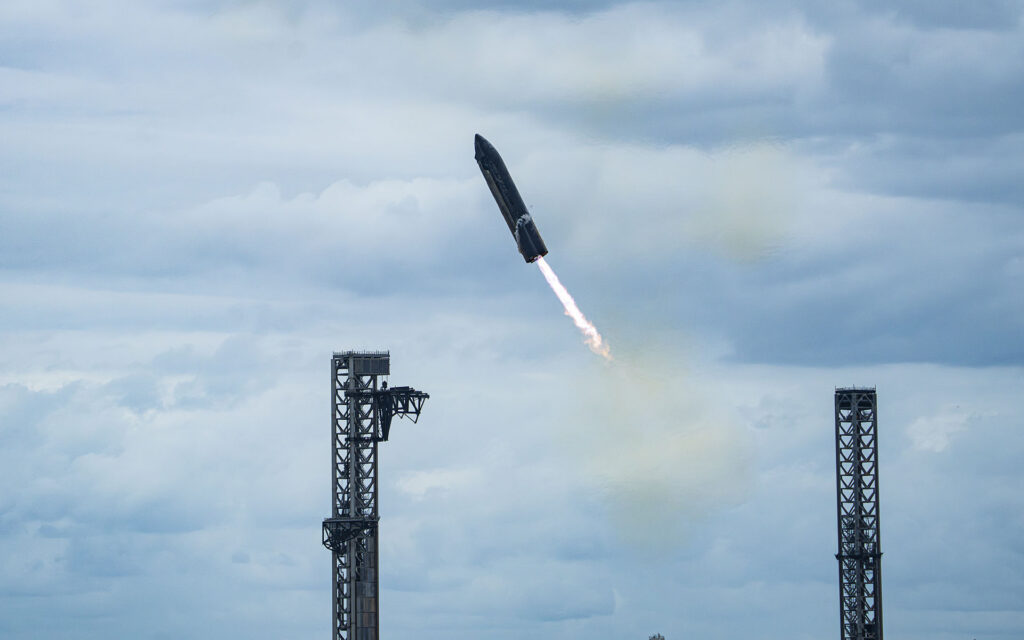
At T+20 hours 32 minutes and 10 seconds, Starship 42 ignited three of its inner-circle sea-level Raptor engines for a landing burn. As the ship got close to the catch tower, 1 out of 3 engines turned off.
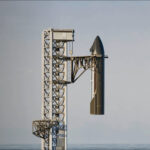
As Starship settled itself inside the catch Chopstick arms, the remaining two engines cut off subsequently. SpaceX employees cheered loudly as the Starship catch pins aligned perfectly with the Chopsticks and the arms held the full load of the ship.
Interestingly, Starship swayed like a pendulum for a few minutes after the catch. SpaceX hurried to lower the ship and attached the Quick-Disconnect (QD) arm to empty the remaining propellant (Methane (CH4) + Liquid Oxygen (LOX) = Methalox) and perform safety and health checks.
Although the double-catch of both Super Heavy and Starship was not achieved in Flight 15, the upper-stage catch was no less of an achievement.
For a detailed log of major events from the Flight 15 mission and live-stream recordings, visit our ~24 hours of live coverage page.
Stay tuned for future updates on Starship and SpaceX. Follow us on:
Google News | X (Twitter) | Flipboard | WhatsApp Channel | RSS (Feedly).
Related Starship News
- The epic story of Flight 15 Starship: ~22 hours in space and a precise landing catch
- Live stream recordings of Starship Flight 15 and live events log archive (liftoff-to-catch coverage)
- The FAA grants SpaceX license for Starship Flight 15, just hours ahead of launch
- Flight 15 Starship double-catch to happen NET Friday the 13th (confirmed)
- SpaceX completes Flight 15 pre-launch static fires and simulations on Starship 42 and Super Heavy (videos)
- Flight 15 catch, Starlink V3, SI ($1T revenue): Key takeaways from Elon Musk’s SpaceX (SPCX) Q3 2026 Earnings Call


 shares stunning footage and information of the Flight 15 Starship landing catch at Starbase, Texas. Read the interesting story, technical details, pics, and more.)