

SpaceX is once again ready to attempt the Flight 13 Starship launch test (IFT-13) after the unexpected failure last Thursday.
Same as in the first attempt, we are covering the 2nd attempt at Starship’s 13th flight test today. Yesterday, in the 2nd attempt, SpaceX chose to stand down from the Flight 13 launch because of unfavorable weather conditions.
According to the latest updates from official SpaceX channels, today’s Flight 13 Starship launch is on track, and everything looks good for a go (Friday, July 24, 2026, 5:45 PM CT / 6:45 PM ET).
You can watch the official Starship Flight 13 live stream webcast below from Elon Musk’s social media platform X.
Additionally, I have added YouTube live video streams of the Flight 12 Starship launch from NasaSpaceFlight.com and Everyday Astronaut below.
You can read the live text updates below, which I will be posting throughout the entire launch and landing test of Flight 13 Starship today.
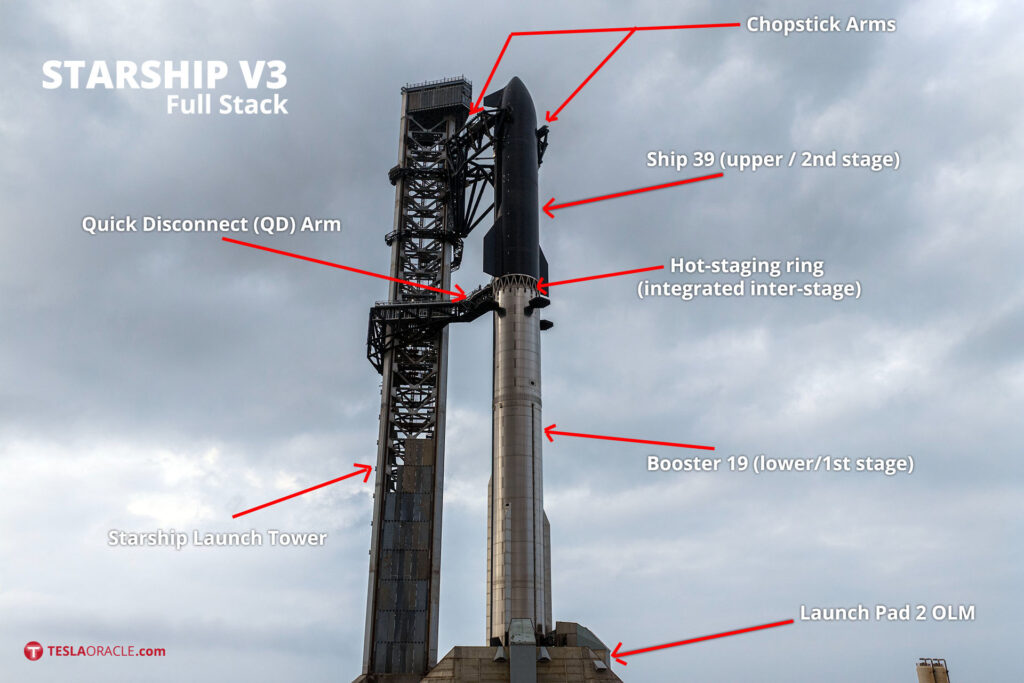
Flight 13 is the 2nd launch and landing test of the Starship V3 generation. I have labeled the fully stacked Starship V3 in the following image to understand the major components of the spacecraft. It will help you understand the live webcast as you get used to the terminology.
Live Stream by SpaceX
Live Stream by NasaSpaceFlight.com (YouTube)
Live Stream by Everyday Astronaut
Starship Flight 13 Live Updates (text commentary)
- Today’s Flight 13 is on track, and SpaceX is going to attempt the launch and landing test (IFT-13)
- We are at T-50 mins to Starship’s 13th launch and landing test
- The official SpaceX live webcast will begin around T-30 mins
- Six Raptor engines had moisture in their pumps in the first attempt last Thursday; this was the reason the safety system shut down all engines automatically
- SpaceX is now targeting 5:51 PM Central Time for liftoff
- The Pad 2 flame-deflector throws water at a rate of 650,000 gallons a minute to save the launch pad from engine thrust and extreme heat
- 33 Raptor 3 engines throw a thrust of 18 million pounds combined at liftoff; it’s like 11 Ford F-150 trucks zipping out of the Super Heavy V3 rocket each second
- A fully integrated V3 (Starship upper stage mounted on Super Heavy booster) is as tall as a 40-story building (407 feet tall)
- SpaceX plans to deploy a million AI satellites into space
- In today’s Flight 13 test (IFT-13), SpaceX plans to deploy 20 Starlink V3 satellites into space
- According to SpaceX, the company is capable and allowed to launch Starship even in lightning conditions
- Starship’s first and 2nd stage are currently going through the propellant-load stage (T-8 minutes)
- Weather is looking great with no clouds at Starbase; perfect visibility is required to observe the test mission
- At T-4 minutes, SpaceX is tracking no holds on the Flight 13 Starship mission
- The flame-diverter activates at T-17 seconds
- Flight 13 Starship Super Heavy booster is aimed at making a soft splashdown landing a few miles off of the Starbase, Texas, coast (Coast of America)
- The upper stage Starship spacecraft is to make a splashdown landing in the Indian Ocean (near Australia)
- T-0 seconds, successful liftoff from Pad 2
- 33 out of 33 Raptor engines lit
- T+1 minutes: Starship reached MaxQ (maximum dynamic pressure)
- Successful stage separation
- All 6 engines are lit on the upper stage Starship 40
- 13 Raptor engines are lit on Booster 20 for coasting and return to Earth
- 13-engine landing burn is used to slow down the Booster on its way back
- Only 5 engines are lit at the end for a soft splashdown landing
- Super Heavy Booster 20 landed in the ocean successfully
- Booster 20 still had more velocity at landing than SpaceX had planned, as the team couldn’t keep all 13 engines lit on landing
- T+9 minutes, upper stage Starship 40 is coasting in space
- SpaceX will attempt to deploy 20 Starlink V3 satellites at T+14 minutes
- These test Starlink V3 satellites will be in space for about 20 minutes; this is the timeframe SpaceX will try to perform maximum tests
- Starship V3 is capable of deploying up to 60 Starlink V3 satellites as payload
- SpaceX successfully deploys Starlink V3 satellites into space from Flight 13 Starship upper stage pez dispenser
- These Starlink V3 satellites will attempt to expand solar panels and connect to ground stations
- 6 of these Starlink satellites are modified to have cameras that will scan the thermal protection heat shield of the upper stage Starship 40
- T+24 mins: 16 satellites deployed, 4 to go
- T+25 mins: Starship velocity is ~27,000 km/h at an altitude of ~200 km above the Earth’s sea surface
- Around T+27 mins: All 20 Starlink V3 satellites are deployed into space
- Next major milestone is a single-engine re-light test at T+37 minutes
- SpaceX successfully made contact with all 20 Starlink V3 satellites, and all of the satellites were able to make laser communications with each other
- Flight 13 is a sub-orbital test; future missions will be aimed at Starship upper stage making it to orbit
- Single-engine re-light was successful at around T+39 mins
- T+44 mins: Starship is starting re-entry to Earth’s atmosphere
- Re-entry will provide valuable data on the usefulness of the thermal protection system (TPS) heat shield tiles
- SpaceX is also testing the forward and aft flaps of the Starship V3 upper stage to control its attitude (angle) at re-entry
- T+1 hour: Starship is at maximum entry dynamic pressure
- Flight 13 Starship survived max heating and max dynamic pressure at re-entry
- Starship 40 made a smooth soft splashdown landing with 3 > 2 > 1 Raptor engine landing burn.
- Congrats, SpaceX team and Elon Musk!!!


. Get the live text updates as the events happen during SpaceX's IFT-13 Starship launch test.)